Slip roads are where a lot of otherwise confident learners quietly come unstuck. You have a short stretch of tarmac, traffic already travelling at 60 or 70mph, a decision to make about a gap you can only see in a mirror, and no option to stop and think about it. It is one of the few parts of a driving test where hesitation is genuinely more dangerous than commitment.
With dual carriageways featuring on test routes at a large number of UK test centres, and motorway lessons now available to learners with an approved instructor, merging is a skill worth getting right well before test day. Here is how examiners assess it and how to practise it.
What a Slip Road Is Actually For
An acceleration lane exists so you can reach the speed of the traffic you are joining before you join it. That is its entire purpose. The most common mistake is treating it as a queue — arriving at the end at 35mph and then trying to slot into traffic moving at 70.
The second most common mistake is the opposite: flooring it down the slip road without ever looking at what you are joining, arriving at the end too fast with no gap available and nowhere to go.
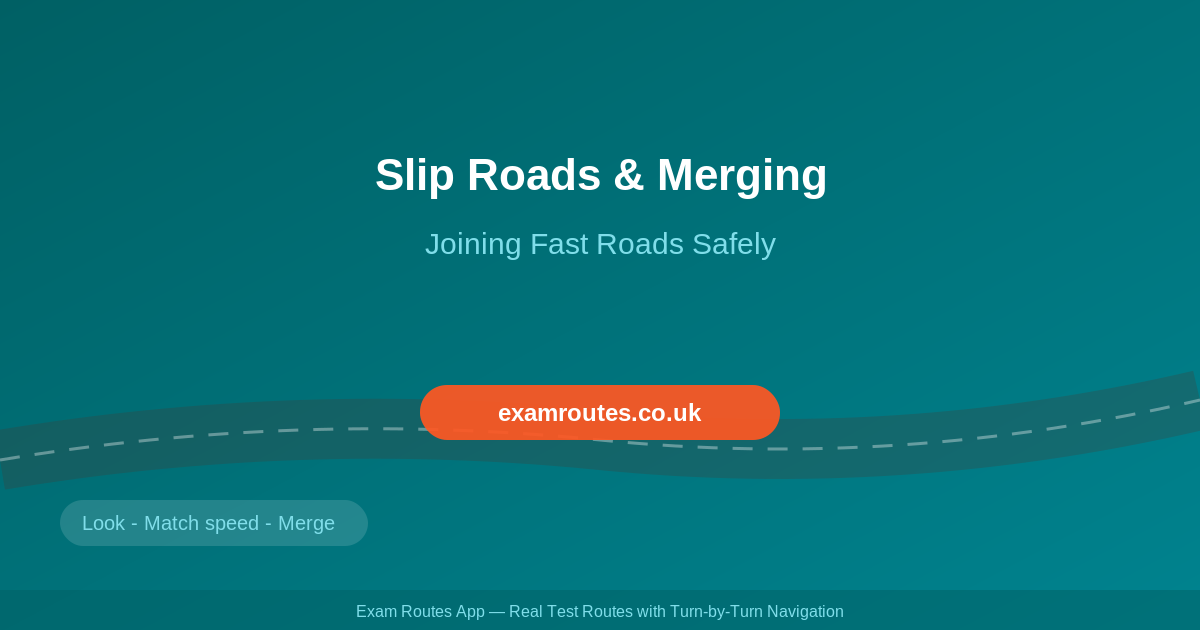
The right approach is a build in three parts: look, match, merge.
Step One: Look Early
Start assessing the main carriageway as soon as the slip road gives you a view of it. Check your right-hand mirror and, where the geometry allows, take a genuine glance over your right shoulder. You are looking for a gap, but more usefully you are looking for the pattern — a solid block of traffic, a gap developing, or a vehicle moving out to lane two to let you in.
Keep looking forward as well. The end of the slip road, any vehicle ahead of you on it, and the hatched markings all need attention.
Step Two: Match the Speed
Build your speed on the slip road so that by the time you reach the merge point you are travelling at roughly the same speed as the traffic in the nearside lane. Merging at a significantly lower speed forces everyone behind you to brake and is marked as a fault because it is genuinely hazardous.
Two practical points. First, in a small-engined car you need to commit to the acceleration earlier than you think — you cannot make up 25mph in the last 50 metres. Second, if the main carriageway is moving slowly or queueing, match that speed instead. Arriving at 70 into stationary traffic is the same error in reverse.
Step Three: Merge Without Forcing
Signal right in good time, take your gap, and move across smoothly. You do not have priority — traffic on the main carriageway does — so you adjust to them, not the other way round.
If the gap closes, adjust your speed and take the next one. What you must not do is stop on the slip road unless traffic is genuinely stationary. Stopping at the end of an acceleration lane on a fast road is one of the more dangerous things a driver can do, and on a test it would be marked as a serious fault.
Once you are in lane one, cancel your signal, settle your speed and restore a safe following distance before doing anything else.
Practise Real Test Routes on Your Phone
The Exam Routes App maps real UK driving test routes with turn-by-turn navigation — including the dual carriageway sections and slip roads your test centre uses.
Leaving by a Slip Road
Exiting is simpler but has its own faults. The sequence is: check mirrors, signal left in good time, move into lane one well before the exit, then use the deceleration lane to slow down — not the main carriageway.
The classic errors are braking on the carriageway before you reach the slip road, and leaving the move to lane one so late that you cross a chevron area or cut across another vehicle. Countdown markers at 300, 200 and 100 yards exist precisely so you can plan this. Use them.
Also watch your speed once you are on the exit slip. After several minutes at 70mph, 40 feels like walking pace. Look at the speedometer rather than trusting the sensation, because the roundabout at the end arrives quickly and speeding on the slip road is a routine fault.
Common Faults Examiners Record
- Joining too slowly and forcing traffic in lane one to brake
- No effective right-shoulder check before merging — mirror only is often not enough
- Stopping at the end of the slip road when traffic is moving
- Merging into the path of another vehicle rather than into a gap
- Forgetting to cancel the signal after joining
- Braking on the main carriageway instead of in the deceleration lane
- Sitting in lane two after merging when lane one is clear
How to Practise Merging
- Find a dual carriageway loop with a junction you can join and leave repeatedly, and drive it a dozen times.
- Practise at different traffic levels. Merging into light traffic is a different skill from merging into a solid stream.
- Commentate the gap. Say which gap you are taking and why, out loud, on the approach.
- Practise the shoulder check until it is automatic and does not pull the steering.
- Consider motorway lessons with an approved instructor if you want the skill fully bedded in before you pass.
- Drive the exact junctions on your test centre’s routes. Slip road length and visibility vary enormously.
How the Exam Routes App Can Help
Not all slip roads are equal. Some give you 300 metres and a clear view; some give you a short, curved lane with a hedge blocking the approach. The Exam Routes App gives you real UK test routes with turn-by-turn navigation so you can practise the specific junctions your test centre uses, and arrive on test day knowing exactly how much room you will have.
Frequently Asked Questions
Do driving tests include slip roads and dual carriageways?
Many do. Test centres with dual carriageways nearby routinely include joining and leaving them, so merging should be part of your preparation.
What speed should I join a dual carriageway at?
Roughly the speed of the traffic already in lane one, built up on the slip road. If that traffic is queueing or slow, match that instead.
Is stopping at the end of a slip road a serious fault?
Yes, unless the traffic you are joining is genuinely stationary. Stopping at the merge point on a fast road is dangerous and would normally be marked as a serious fault.
Do I have priority when joining from a slip road?
No. Traffic already on the main carriageway has priority. You adjust your speed and position to fit a gap.
Can learner drivers take motorway lessons?
Yes, with an approved driving instructor in a car fitted with dual controls. It is voluntary, but it builds merging confidence well before you pass.
Don’t Leave Your Test to Chance
Download the Exam Routes App for real UK test routes with turn-by-turn navigation and practise the junctions that actually appear.