Private practice is one of the strongest predictors of passing first time. Yet most supervising drivers — usually a parent, partner or older sibling — get almost no guidance on what they are supposed to do beyond sitting there and trying not to flinch.
This is a practical guide for 2026: the legal requirements, the insurance question everyone gets wrong, and how to make two hours in the passenger seat genuinely useful rather than stressful for both of you.
The Legal Rules for Supervising a Learner
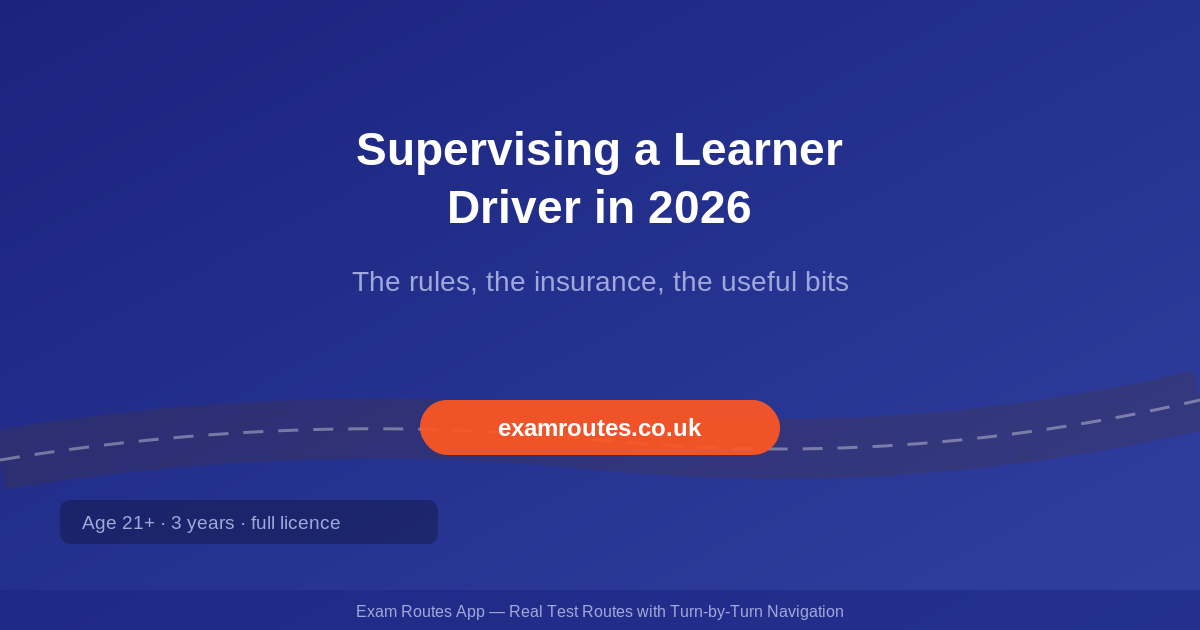
To supervise a learner driver in a car in Great Britain, you must:
- Be at least 21 years old
- Hold a full driving licence for the category of vehicle being driven (a manual licence if the learner is driving a manual)
- Have held that licence for at least three years
- Not be paid for the lesson unless you are an approved driving instructor
The learner must hold a valid provisional licence, and the car must display L plates (or D plates in Wales) on the front and rear, be taxed, insured and roadworthy. Learner drivers in cars are not permitted on motorways unless accompanied by an approved driving instructor in a dual-control car.
You are also, in practical terms, responsible. A supervising driver can be prosecuted for offences committed by the learner in some circumstances, and the same drink-drive limits apply to you as they would if you were driving. Supervising after a couple of drinks is not a grey area — it is an offence.
The Insurance Question Everyone Gets Wrong
A learner driving your car is not automatically covered by your policy. This is the single most common and most expensive misunderstanding in private practice.
You have two realistic options:
- Add the learner as a named driver on the car’s existing policy. Check first that the insurer permits provisional licence holders, and be aware it can affect the policy premium.
- Take out short-term learner driver insurance in the learner’s own name, covering them to drive a specified car. This is now widely available by the hour, day or month, and in many cases it protects the car owner’s no-claims bonus if there is a claim.
Check before the first drive, not after. Driving without valid insurance carries six to eight penalty points and a fine, and those points land on the learner licence before they have even passed.
Practise Real Test Routes on Your Phone
The Exam Routes App gives you access to real driving test routes with turn-by-turn navigation. Practise at your own pace and build confidence before test day.
How to Actually Be Useful in the Passenger Seat
The instinct of most supervising drivers is to narrate every hazard. It feels helpful. It usually is not, because the learner stops scanning and starts waiting to be told.
A better approach:
- Agree the goal before you set off. “Today is roundabouts” is far more productive than “let’s just drive around”.
- Stay quiet during the manoeuvre, debrief afterwards. Talking through a reverse while they are doing it splits their attention.
- Ask questions instead of giving instructions. “What did you see at that junction?” builds observation. “Look left!” does not.
- Intervene only for safety. One calm, specific word — “brake” — is better than a sharp intake of breath.
- Keep sessions short. Forty-five focused minutes beats a two-hour drive that ends in an argument.
- Do not contradict the instructor. If your habits differ from what they have been taught, the instructor’s method wins. Raise it with the instructor, not mid-junction.
What to Practise Between Lessons
Professional lessons are where new skills are introduced. Private practice is where they become automatic. The most valuable things to repeat are:
- Manoeuvres in different places. Bay parking in three different car parks is worth more than thirty attempts in one.
- Roundabouts at varying traffic levels. Quiet ones first, then busier ones.
- Roads at the speed your test will use. If the local routes include a 60mph stretch, do not avoid it.
- Independent driving. Give a destination and let them navigate with signs or a sat nav, exactly as the test does for around twenty minutes.
- Different conditions. Rain, dusk and early-morning light all change what the road looks like.
How Exam Routes App Can Help
Supervising drivers often say the hardest part is deciding where to go. The Exam Routes App solves that directly: it maps real test routes around UK test centres with turn-by-turn navigation, so a practice session has a clear plan and covers the road types the examiner will actually use.
It also takes the pressure off you. Instead of improvising directions while watching the road, you can focus on the one job that matters — watching how they drive and giving calm, useful feedback afterwards.
Frequently Asked Questions
Who can legally supervise a learner driver in the UK?
Anyone aged 21 or over who holds a full licence for that category of vehicle and has held it for at least three years. They must not be paid unless they are an approved driving instructor.
Does my insurance cover a learner driving my car?
Not automatically. You need to add the learner as a named driver with the agreement of the insurer, or the learner needs their own short-term learner driver policy covering that vehicle.
Can a learner drive on the motorway with a parent?
No. Learner drivers in cars may only use motorways when accompanied by an approved driving instructor in a car fitted with dual controls.
How many private practice hours should a learner do?
DVSA figures have long suggested around 45 hours of professional tuition plus roughly 22 hours of private practice as a typical route to passing, though individuals vary considerably.
Can the supervising driver be prosecuted?
Yes, in certain circumstances. A supervising driver is expected to be fit and able to take control, must not be over the drink-drive limit, and can face action for offences such as permitting uninsured driving.
Ready to Pass? Download Exam Routes Now
Give every private practice session a plan — real test routes with turn-by-turn navigation, so supervising drivers can focus on feedback instead of directions.