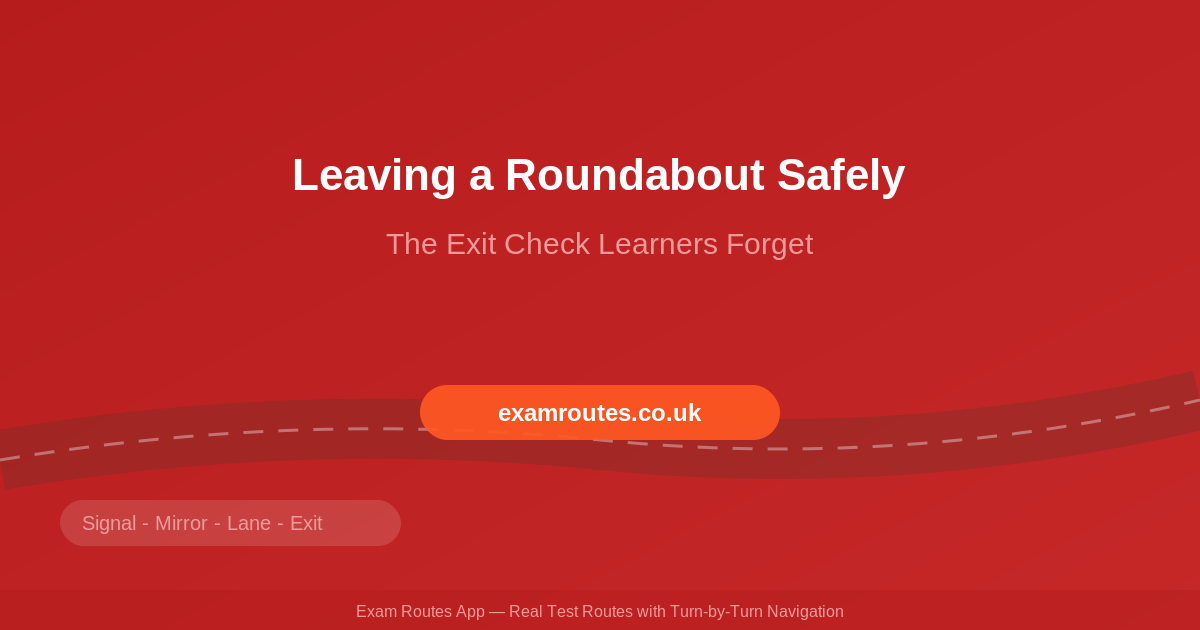
Most roundabout coaching stops at the moment you reach the give-way line. Approach speed, lane choice, observation to the right, timing the gap — and then the lesson moves on. The result is a generation of learners who are good at joining roundabouts and noticeably weaker at leaving them, which is a problem, because the exit is where a large share of roundabout faults are actually recorded.
This guide covers what happens in the last few seconds of a roundabout: the signal, the mirror check nobody does, the lane you end up in, and how to recover when you realise you are about to miss your exit.
Why the Exit Matters More Than the Entry
When you join a roundabout you are looking at traffic coming from one direction and you are travelling slowly. When you leave, you are travelling faster, you may be crossing a lane, and there could be a vehicle alongside you that was not there ten seconds ago. The risk profile is completely different, and examiners know it.
The faults recorded at roundabout exits usually fall into four categories: signalling too early or not at all, failing to check the nearside mirror before moving left, cutting across another lane, and accelerating away without looking at what is on the exit road — a queue, a pedestrian crossing, or a cyclist.
The Signal: Timing Is Everything
The rule is simple and consistently misapplied. Signal left after you pass the exit before the one you want. Signal any earlier and drivers waiting to join will think you are coming off at the exit before yours and may pull out in front of you. Signal later, or not at all, and nobody behind or beside you knows your intention.
On a small roundabout with exits close together, that leaves very little time. The trick is to have already decided which exit you want before you reach the give-way line, so the signal is a reflex rather than a decision made under pressure.
If you are taking the first exit, signal left on the approach and keep it on. If you are going straight ahead, no signal on approach, then signal left after the first exit. If you are turning right or going full circle, signal right on approach and switch to left after the exit before yours.
The Mirror Check Almost Everyone Forgets
On a multi-lane roundabout, if you are in the right-hand or middle lane and need to move left to exit, you are performing a lane change at speed inside a junction. That requires a left mirror check, and on many roundabouts a glance over your left shoulder as well.
This is the single most commonly missed observation in the whole roundabout sequence. A motorcyclist or a car that entered from the exit before yours can be sitting exactly in your blind spot. Checking after you have started moving is not a check — it is a reaction.
Build it into a rhythm: decide, signal, check left, move, exit. Say it out loud during practice until it stops needing conscious thought.
Practise Real Test Routes on Your Phone
The Exam Routes App gives you real driving test routes with turn-by-turn navigation, including the multi-lane roundabouts that appear on tests across the UK.
Holding Your Lane Through the Exit
Lanes on the exit road are often marked, and they usually correspond to the lane you were in on the roundabout. Left lane goes to left lane, right lane goes to right lane. Drifting across as you leave — even with nothing beside you — is recorded as a positioning fault, and if there is another vehicle it becomes a serious one.
Keep your steering input smooth. The most common cause of an untidy exit is turning the wheel too much on the roundabout itself, so that you arrive at the exit pointing the wrong way and have to correct.
Looking at the Exit Road Before You Commit
An exit is not a finish line. Before you accelerate away, look at what is on the road you are joining:
- A queue of stationary traffic close to the roundabout — joining it and blocking the roundabout is a fault
- A pedestrian crossing a few metres from the exit, which is increasingly common on new layouts
- A cyclist in the nearside, particularly where a cycle lane rejoins the carriageway
- A change in speed limit as you leave — roundabouts often sit at boundaries between limits
Look at the exit while you are still on the roundabout, not after you have committed to it.
What If You Miss Your Exit?
Go round again. That is it. Missing an exit on a driving test is not a fault. Swerving across two lanes at the last second, braking hard on a roundabout, or stopping to think about it — those are faults, and potentially serious ones.
On a sat nav section the device will re-route within a few seconds. The examiner has seen this hundreds of times and will simply wait. Your job is to keep driving safely, not to obey the sat nav.
How to Practise the Exit Specifically
- Pick one multi-lane roundabout and drive every exit from every approach. Repetition is what makes the lane logic obvious.
- Commentate. Say “third exit, right-hand lane, signalling now, checking left, moving” out loud every time.
- Practise the deliberate miss. Go round twice on purpose so the experience is boring rather than alarming.
- Drive the same roundabout at two different times of day. Quiet and busy require different gap judgement.
- Get a passenger to check your mirror use. Most learners are convinced they check left when they do not.
How the Exam Routes App Can Help
Roundabouts are the part of the test where local knowledge counts most, because every layout is different. The Exam Routes App maps real UK driving test routes with turn-by-turn navigation, so you can practise the actual roundabouts your test centre uses — and get the exit sequence working on the layouts that will appear on the day.
Frequently Asked Questions
When should I signal to leave a roundabout?
Signal left after you pass the exit before the one you want. Signalling earlier misleads drivers waiting to join, and is a common fault.
Do I need to check my mirror when leaving a roundabout?
Yes. If you are moving left out of a middle or right-hand lane, you are changing lanes at speed — check the left mirror and, on wider roundabouts, the blind spot.
Is missing your exit on a roundabout a driving test fail?
No. Going round again is perfectly acceptable. The fault would be swerving, braking sharply or stopping to think about it.
Which lane should I be in on the exit road?
Normally the lane that corresponds to the one you were in on the roundabout — left to left, right to right — unless markings indicate otherwise.
What if the sat nav tells me to take an exit I have already passed?
Keep driving safely and let it re-route. The examiner marks your driving, not your navigation.
Get the Edge on Test Day
Download the Exam Routes App and practise real roundabouts on real test routes, with turn-by-turn navigation.