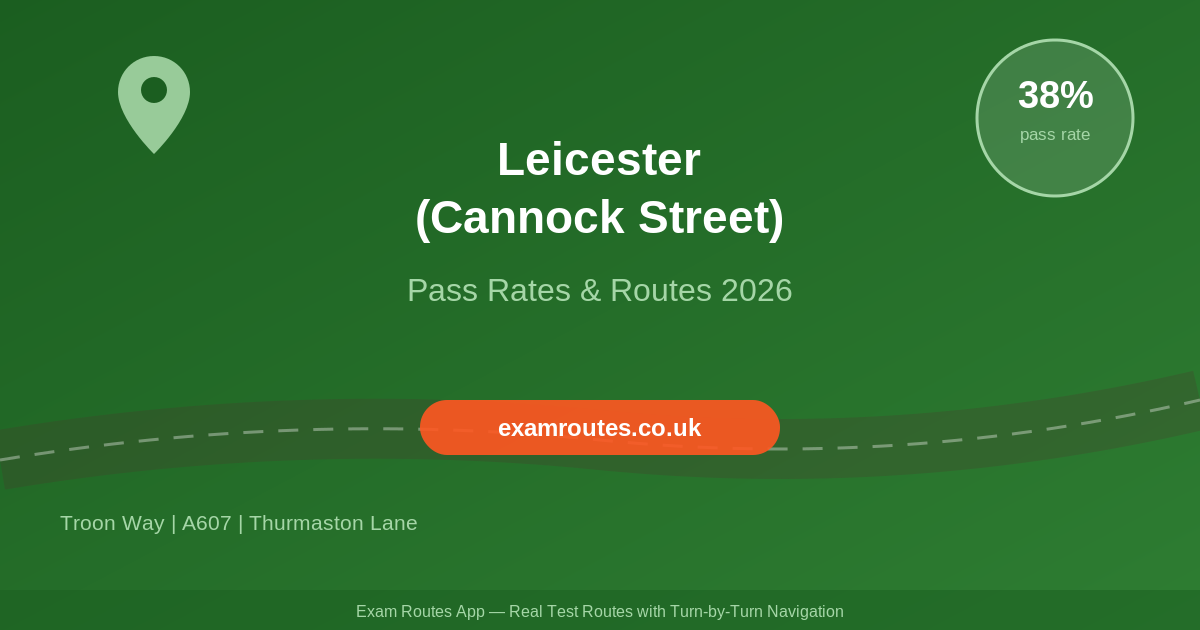
If you have been told that Leicester is a tough place to take your driving test, the numbers behind that reputation come mostly from one centre. Leicester (Cannock Street) has been running at around a 38% pass rate — roughly ten points below the national average and among the lower figures anywhere in the East Midlands. Barely more than one candidate in three drives away with a pass.
That is a statistic worth understanding rather than fearing. Cannock Street is not staffed by unusually harsh examiners; it is surrounded by a specific combination of roads — a working industrial estate, a fast ring road and a set of large, multi-lane roundabouts — that punishes anyone who has practised only in quiet residential areas. This guide explains exactly what those roads are and how to prepare for them in 2026.
About Leicester (Cannock Street) Test Centre
The centre sits at 40 Cannock Street, off Barkbythorpe Road, Troon Industrial Estate, Leicester, LE4 9HT, in the north-east of the city. It is an industrial estate location, so the immediate surroundings are units, delivery vehicles and HGVs rather than housing.
Parking is available for candidates, but arrive with a few minutes in hand because the estate roads can be congested with commercial traffic, particularly mid-morning and late afternoon. Bring your provisional photocard licence, and if you are supplying the car, check tax, insurance, MOT, tyre tread and lights the day before rather than the morning of.
Waiting times here have recently been in the region of 12–13 weeks, which is shorter than several nearby centres. Combined with the low pass rate, that produces a pattern worth naming: some candidates book Cannock Street for speed, arrive underprepared for the road types, and the pass rate stays low. Do not be one of them.
The Routes: Roads You Can Expect
Test routes from Cannock Street draw on a fairly consistent set of roads across the north-east of Leicester.
Cannock Street and the Troon Industrial Estate
Your test begins and ends among lorries, vans and forklifts crossing between units. Expect vehicles pulling out without full observation, and parked commercial vehicles obstructing your view. Slow, deliberate and well-positioned is the right approach.
Troon Way (A563 outer ring road)
The nearby Troon Way roundabout is a near-certainty on your test. This is a large, multi-lane junction feeding the A563 outer ring road, and it demands early lane selection, correct signalling and the confidence to keep moving. It is the single most common source of serious faults at this centre.
Thurmaston Lane and Barkby Road
Busy connecting roads with side turnings, bus stops and parked vehicles. During rush hour, queues build here, so you will be assessed on how you handle stop-start traffic, keeping a safe following distance and not blocking junctions.
Victoria Road East and Gipsy Lane
Residential and semi-residential roads with pedestrian crossings, cyclists and frequent give-way situations. This is where meeting traffic, pulling up on the left and the reverse manoeuvres tend to be examined.
The A607 Melton Road corridor
A busier route out through Thurmaston with shops, side roads, buses and pedestrians stepping out between parked cars. Anticipation and planning are what the examiner is looking for.
Quick tip: Practise the Troon Way roundabout from every approach, and practise it at 8:30am as well as 11am. The lane you need does not change, but the space you get to move into does.
Tricky Spots & Common Challenges
- Troon Way roundabout lane discipline. Getting into the correct lane too late, then either straddling lanes or cutting across on exit. This is the classic Cannock Street failure.
- Merging onto the A563 ring road. Needs a decisive, well-timed join. Crawling to the give-way line and stopping when there was a clear gap is marked as undue hesitation.
- HGVs on the estate. Large vehicles manoeuvring across the carriageway. Stopping in a sensible place, well back, with clear observation, is the safe answer.
- Rush-hour Thurmaston Lane. Queueing traffic and box-junction style situations. Do not enter a junction unless your exit is clear.
- Pedestrian crossings on Melton Road. Multiple crossing types in a short stretch. Know your zebra from your puffin and cover the brake on approach.
- Sat-nav independent driving. Junctions come close together in north-east Leicester, so instructions arrive late. Follow road signs if the sat nav is unclear — the examiner will not fault you for a wrong turn taken safely.
Pass Rates & Statistics
Recent DVSA data puts Leicester (Cannock Street) at roughly 38%. For comparison, Leicester (Wigston) has been around 41%, Hinckley around 50%, Loughborough around 44% and Melton Mowbray around 61%.
The pattern across those centres is instructive. The rural and small-town centres score highest; the urban centres with ring-road access score lowest. That is not about examiner standards, which are national. It is about how many complex, high-consequence decisions a candidate has to make per mile — and around Cannock Street, that number is high.
The encouraging corollary: candidates who genuinely practise these roads pass at a much better rate than the headline figure suggests. The average is dragged down by people meeting a multi-lane ring-road roundabout for the first time under test conditions.
Practise Real Test Routes on Your Phone
The Exam Routes App gives you access to real driving test routes with turn-by-turn navigation. Practise at your own pace and build confidence before test day.
Top Tips for Passing at Leicester (Cannock Street)
- Own the Troon Way roundabout. If you can approach it from all directions without hesitating, you have removed the most likely reason for failing here.
- Practise emerging from the industrial estate during working hours, with real lorries in the way — not on a quiet Sunday.
- Build ring-road confidence. Regular runs on the A563 at 50–60 mph so that dual-carriageway speed feels normal, not exciting.
- Read lane markings early. On Leicester’s larger junctions, the paint and the overhead signs come before the point where you can safely change lanes.
- Keep your following distance in queues. Two seconds minimum, more in the wet. Tailgating in Thurmaston Lane traffic is a common fault here.
- Book a lesson at the same time of day as your test. Traffic on Barkbythorpe Road at 9am bears no resemblance to 2pm.
- Do not let the pass rate get in your head. You are not being marked against the average. You are being marked against the DL25 standard, which is the same everywhere in Britain.
How the Exam Routes App Can Help
The gap between a 38% centre and a 60% centre is mostly familiarity. The Exam Routes App lets you drive real test routes around Leicester with turn-by-turn navigation, so Troon Way, Thurmaston Lane and the Melton Road corridor stop being surprises and start being roads you have already driven a dozen times.
Practise them with a supervising driver in the weeks before your test, and the examiner’s instructions become confirmation of what you already expected rather than new information to process at speed.
Frequently Asked Questions
What is the pass rate at Leicester Cannock Street?
Around 38% in recent DVSA data, which is roughly ten percentage points below the national average and among the lowest in the East Midlands. The route mix — ring road, multi-lane roundabouts and industrial traffic — is the main reason.
Where is the Leicester Cannock Street test centre?
40 Cannock Street, off Barkbythorpe Road, Troon Industrial Estate, Leicester, LE4 9HT, in the north-east of the city. Candidate parking is available.
Should I book Wigston instead?
Wigston runs a few points higher at around 41%, but its routes have their own challenges. The bigger factor is which roads you have actually practised. Choose the centre whose roads you know, not the one with the marginally better number.
Which roundabout should I practise most?
Troon Way. It feeds the A563 outer ring road, appears on the majority of routes, and lane discipline errors there are the most common cause of serious faults at this centre.
How long is the wait for a test at Cannock Street?
Recently around 12–13 weeks, shorter than several nearby centres. Availability is one reason candidates book here — just make sure you have practised the road types before you do.
Don’t Leave Your Leicester Test to Chance
Download the Exam Routes App and practise the real routes around Cannock Street before you sit in the examiner’s chair.