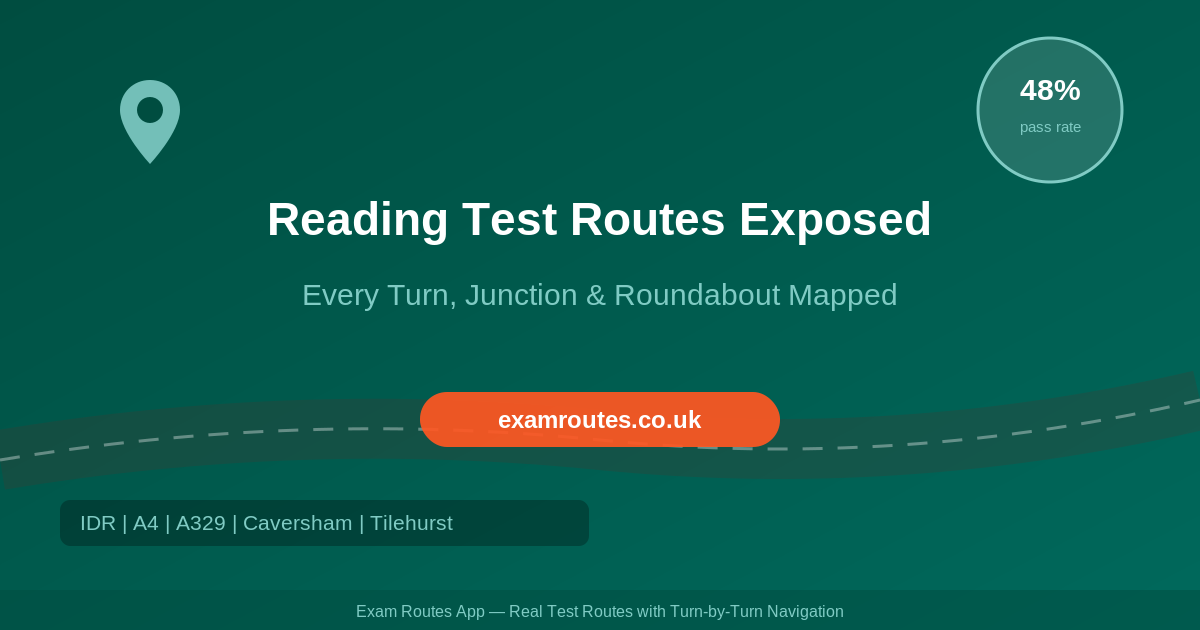
Reading is a deceptively demanding test centre. On paper it looks friendly — a car pass rate in the high 40s, roughly in line with the national average of around 50%. In practice, Reading routes contain a feature that almost no other centre of its size has: the Inner Distribution Road, a multi-lane urban dual carriageway that rings the town centre with short slip roads and closely spaced junctions. Get the IDR right and Reading is very passable. Get it wrong and the rest of your test barely matters.
This guide maps out what Reading routes are actually made of, junction by junction, so you can practise the right roads instead of driving around hoping to bump into them.
About Reading Driving Test Centre
| Recent car pass rate | Around 46–50%, close to the national average |
| Signature feature | The IDR (Inner Distribution Road) urban dual carriageway |
| Suburbs on routes | Caversham, Tilehurst, Earley, Whitley, Southcote |
| Key A-roads | A4 Bath Road / London Road, A329, A33 Relief Road |
| Test length | Roughly 38–40 minutes including 20 minutes independent driving |
| Nearest alternatives | Newbury (Greenham), Slough, Basingstoke |
Reading’s catchment pulls in learners from a wide area of Berkshire and south Oxfordshire, and the centre is busy year-round. Waiting times have been long, in line with the national picture. Arrive with your provisional licence and a car that is taxed, insured, MOT’d and mechanically sound — a faulty light or worn tyre is enough to have the test cancelled and the fee lost.
The Routes: Mapped Section by Section
1. The suburban warm-up
Most Reading routes open with residential driving — typically towards Whitley, Southcote or Earley depending on the direction of travel. Terraced streets, parked cars on both sides, unmarked crossroads and plenty of side turns. This section tests meeting traffic, junction observation and speed control in a 20 or 30mph limit.
2. The A4 corridor
Bath Road to the west and London Road to the east give the examiner a busy multi-lane A-road with bus lanes, signal-controlled junctions and frequent pedestrian crossings. Lane discipline and reading signs early are the skills on display.
3. The IDR
This is the section that defines Reading. The Inner Distribution Road loops around the town centre as a dual carriageway with tight, frequent junctions and short slip roads. You will be asked to join it, hold a lane, and leave at a specific exit — often during the independent driving phase, so you are following a sat nav while doing it.
What examiners watch for on the IDR: mirror checks before every speed or lane change, matching traffic speed on the slip road rather than crawling on, choosing the correct lane well before the exit, and not drifting between lanes on the curves.
4. Caversham and the Thames bridges
Routes heading north cross the river into Caversham. Caversham Bridge and Reading Bridge funnel traffic tightly, and the streets on the far side are narrow and steep in places, with awkward junctions and limited visibility. Hill starts and meeting traffic on narrow roads both feature.
5. Tilehurst and the west
Tilehurst brings gradients — genuine hills by southern England standards — along with residential grids and roundabouts. Clutch control and hill starts are commonly assessed here in a manual car.
6. The faster edge
Some routes stretch towards the A33 relief road, Burghfield or the approaches to M4 Junction 11, giving a national speed limit or 50mph section with proper roundabout work.
Practise Real Test Routes on Your Phone
The Exam Routes App gives you access to real driving test routes with turn-by-turn navigation. Practise at your own pace and build confidence before test day.
The Roundabouts That Decide Your Test
- The IDR junctions. Signal-controlled rather than conventional roundabouts in places, with lane assignment painted on the road. Read the surface markings, not just the signs.
- Cemetery Junction (A4/A329). A complex, busy junction where the London Road meets Wokingham Road. Lane choice must be made before you arrive.
- Caversham Bridge and Richfield Avenue. Heavy traffic, pedestrians and cyclists, and a lane structure that changes as you approach the bridge.
- Whitley Wood and Rose Kiln Lane roundabouts. Multi-lane, with exits that come up quickly. A classic spot for taking the wrong lane and then correcting it late.
- Tilehurst mini-roundabouts. Small, sometimes in pairs, and easy to overrun. Give way to the right and keep the painted circle to your right where the road layout allows.
- M4 Junction 11 approaches. Large-scale roundabout work with high-speed approaches on some longer routes.
Pass Rates & Statistics
Reading’s car pass rate has been running at roughly 46 to 50%, placing it around the national average of about 50%. That is notably better than most London centres and broadly comparable to other large southern towns.
The pattern in Reading is interesting: candidates who fail here often fail on a single serious fault during the IDR or independent driving section, having driven the residential parts cleanly. It is a test where one bad ninety seconds can undo thirty-eight good minutes. That is a strong argument for practising the harder sections disproportionately.
Top Tips for Passing at Reading
- Spend most of your practice time on the IDR. Not because you will spend most of your test there, but because that is where the marks are lost.
- Practise sat nav following on dual carriageways. Hearing “take the second exit” while changing lanes is a genuinely different skill from following an instructor’s voice.
- Get your hill starts solid before you go near Tilehurst or Caversham. A rollback on a hill start is an avoidable fault.
- Learn Cemetery Junction in both directions. It appears on a large proportion of eastbound routes.
- Check bus lane times on the A4. The hours vary and the signs are the authority.
- Do not slow down excessively for roundabouts. Approach at a speed that lets you go if the gap is there. Stopping unnecessarily at a clear roundabout is undue hesitation.
- Book a lesson at the same time of day as your test. Reading’s traffic is very different at 9am, midday and 4pm.
How Exam Routes App Can Help
Reading is a centre where knowing the geography genuinely changes the outcome. The Exam Routes App gives you real driving test routes with turn-by-turn navigation, so you can drive the IDR loop, the A4 corridor and the Caversham crossings deliberately rather than stumbling onto them.
Practise with your instructor or a supervising driver, repeat the sections that make you tense, and arrive on test day already knowing which lane you need before the sign appears.
Frequently Asked Questions
What is the IDR and why does it matter so much?
The Inner Distribution Road is a multi-lane dual carriageway ringing Reading town centre, with short slip roads and closely spaced junctions. It appears on most test routes and is where a large share of serious faults happen.
Is Reading an easy test centre?
It is around the national average, so neither easy nor unusually hard. It is easier than most London centres and harder than a rural centre. Local practice matters more than the headline figure.
How long do I have to wait for a test at Reading?
Waits have been long across the country and Reading is a busy centre. Checking the official DVSA booking service regularly for cancellations is the legitimate route to an earlier slot.
Which manoeuvre is most common at Reading?
All four possible manoeuvres are used: bay parking, parallel parking, pulling up on the right and reversing two car lengths, and the forward bay park. Practise all of them — you cannot predict which you will get.
Do Reading routes go on the motorway?
No. Learner practical tests do not use motorways. Some routes go near M4 Junction 11 but stay on the surrounding roads and roundabouts.
Get the Edge on Test Day in Reading
Download the Exam Routes App and practise the IDR, Cemetery Junction and the Caversham crossings with real turn-by-turn route guidance.