Most guides to Exeter tell you which roads you will drive. Fewer tell you what the examiner sitting next to you is actually writing down. Those are different questions, and the second one is more useful.
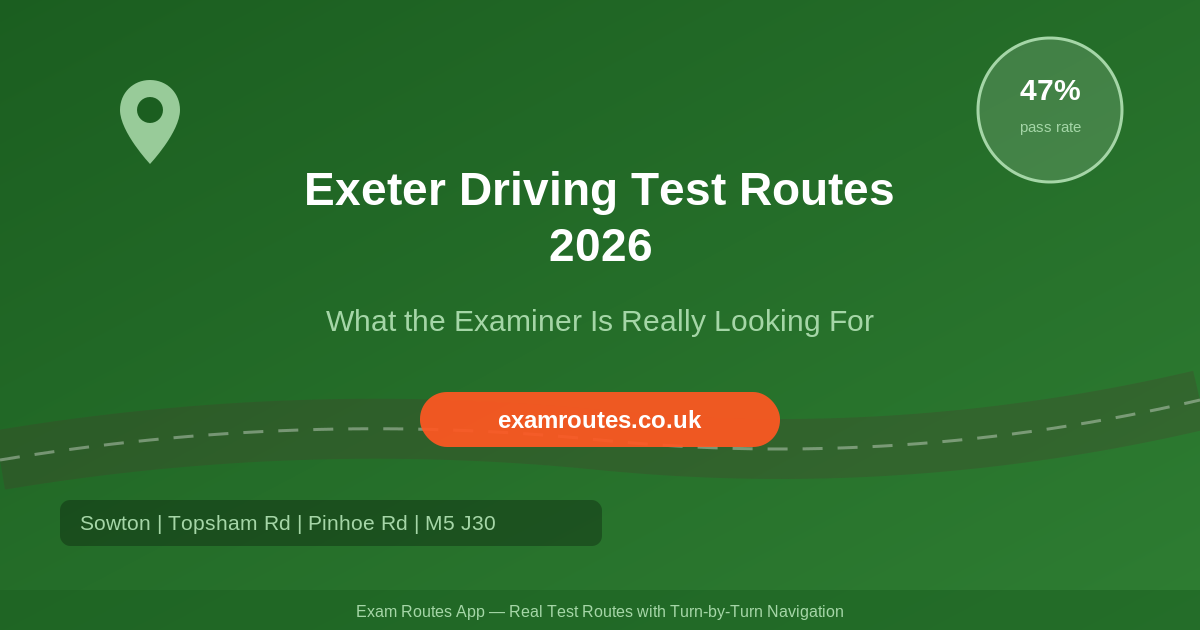
Exeter’s car pass rate has been running in the mid-to-high 40s, close to the national average of around 50%. The centre operates from Heron Road on the Sowton Industrial Estate, EX2 7LL, on the eastern edge of the city near the M5. From there, examiners can build routes that take in city one-way systems, fast dual carriageway, estuary roads and genuine Devon lanes — an unusually wide range for a single centre.
About Exeter Driving Test Centre
| Address | Heron Road, Sowton Industrial Estate, Exeter EX2 7LL |
| Recent car pass rate | Around 45–48%, close to the national average |
| Route variety | City centre, dual carriageway, estuary roads, rural lanes |
| Key roads | A30, A379, A376, Topsham Road, Pinhoe Road, Western Way |
| Signature junction | M5 Junction 30 roundabout |
| Nearest alternatives | Taunton, Barnstaple, Torquay, Plymouth |
The Sowton estate itself sets the tone. It is a working industrial park with roundabouts, traffic lights, HGVs and delivery vehicles, and your test will begin and end there. The bay parking manoeuvre is often carried out in the estate bays.
What the Examiner Is Assessing, Section by Section
Leaving Sowton: observation under time pressure
The estate roundabouts come quickly one after another. The examiner is checking whether you are making effective observations before you commit, whether your speed on approach lets you go without stopping when the gap is clear, and whether you signal correctly on exit. Stopping at an empty roundabout is marked as undue hesitation just as surely as pulling out in front of someone is marked as a serious fault.
Pinhoe Road: junction discipline
Pinhoe Road strings together multiple junctions and roundabouts with residential turnings in between. The examiner is watching your mirror-signal-manoeuvre routine repeat cleanly, junction after junction, without drifting or leaving the signal on.
Topsham Road: lane choice and planning
Topsham Road offers several lane decisions on the way south. The assessment here is planning: are you in the right lane early, positioned correctly, and aware of what is behind you before you move?
The city one-way system, Bonhay Road and Western Way
Exeter’s inner bypass and one-way system throw multiple lanes, bus lanes, cycle lanes and closely spaced exits at you. The examiner is looking for lane discipline and correct response to road markings and signs. This is where candidates who have only driven suburban Exeter tend to unravel.
The A30 and M5 Junction 30: progress at speed
On the dual carriageway sections, the examiner assesses whether you join at a sensible speed, keep left unless overtaking, check mirrors before every change, and maintain a safe following distance. Driving at 50 in a 70 because you feel safer is not safer — it is a fault.
The Devon lanes and A376 estuary roads
On some routes you will meet narrow rural roads with high hedges, blind bends, passing places and mud on the surface. The examiner is watching your speed relative to what you can see, your positioning to maximise your view, and your willingness to hold back and give way.
Practise Real Test Routes on Your Phone
The Exam Routes App gives you access to real driving test routes with turn-by-turn navigation. Practise at your own pace and build confidence before test day.
Tricky Spots & Common Challenges
- M5 Junction 30 roundabout. Large, multi-lane, with heavy traffic joining from the motorway. Lane choice must be settled well before you arrive.
- The Sowton estate roundabouts. Deceptively simple, but they come in quick succession and HGVs cut across lanes.
- Bonhay Road and the inner bypass. Multiple lanes with short gaps between exits, plus bus lanes with operating hours.
- Blind bends on the Devon lanes. The rule is simple and rarely followed: you must be able to stop within the distance you can see to be clear.
- Cyclists on Topsham Road and the city corridors. Exeter has significant cycle traffic. Passing distance and patience are assessed.
- Hill starts in the city. Exeter is not flat. Junctions on gradients are common, particularly north and west of the centre.
- Pedestrian crossings near the university and city centre. High footfall, especially in term time.
Pass Rates & Statistics
Exeter’s car pass rate of roughly 45 to 48% sits near the national average of about 50%. It is a middling figure that hides an interesting split: candidates who have practised the city centre and dual carriageway sections tend to do well, while those who have concentrated on quiet suburban roads and lanes are more likely to be caught by the one-way system or the A30.
Remember what the marking allows. You may accumulate up to 15 driving faults and still pass. A single serious or dangerous fault ends the test as a fail. The practical lesson is that a scattering of small imperfections will not sink you — one moment of poor observation at a roundabout will.
Top Tips for Passing at Exeter
- Practise the one-way system deliberately. It is the section most likely to produce a serious fault, and the section learners avoid in lessons.
- Do repeated laps of the Sowton estate roundabouts. Your test starts there; a clean first five minutes is worth a lot psychologically.
- Get real dual carriageway time on the A30. Joining, lane discipline, and leaving at the correct exit.
- Learn to read Devon lanes. Slow enough to stop in the distance you can see, positioned for the best view, and ready to reverse to a passing place.
- Rehearse the bay park in the estate. Practise reversing into a bay with vehicles either side, not into an empty row.
- Watch your following distance. The two-second rule doubles in the wet. Devon gets a lot of rain.
- Make progress. Examiners across the country mark undue hesitation frequently. Appropriate speed for the conditions is part of safe driving, not a bonus.
How Exam Routes App Can Help
Exeter’s routes cover more types of road than almost any comparable centre, which makes structured practice especially valuable. The Exam Routes App gives you real driving test routes with turn-by-turn navigation, so you can cover the city one-way system, Pinhoe Road, Topsham Road, the A30 and the lanes in the same sequence an examiner might.
Drive each route two or three times with your instructor or a supervising driver. By the third run you will be thinking about your mirrors instead of your next turning — which is exactly the shift examiners reward.
Frequently Asked Questions
Where exactly is the Exeter test centre?
Heron Road on the Sowton Industrial Estate, EX2 7LL, on the eastern side of the city close to the M5. Despite older references to Ide, this is the operating location.
What is the pass rate at Exeter?
Around 45 to 48% for car tests, close to the national average of roughly 50%. Figures vary slightly depending on the reporting period.
Do Exeter test routes include rural lanes?
Yes, some do. Expect narrow roads with high hedges, blind bends and passing places on routes heading away from the city.
Is the M5 used on the test?
No. Learner practical tests do not use motorways. The M5 Junction 30 roundabout, however, features regularly.
How many minor faults are allowed at Exeter?
The same as everywhere in Great Britain: up to 15 driving faults. Any serious or dangerous fault results in a fail.
Get the Edge on Test Day in Exeter
Download the Exam Routes App and practise real Exeter routes — Sowton, the one-way system, the A30 and the lanes — with turn-by-turn guidance.