Canterbury has a reputation among Kent learners as one of the better centres to book, and the numbers broadly support it – recent reporting has put the centre several points above the national average. What the headline figure does not tell you is how roundabout-heavy Canterbury routes are. Analysis of mapped routes around the centre regularly puts Canterbury well above the typical UK centre for roundabouts per test.
If roundabouts are your weak point, Canterbury will find it. If they are not, the centre offers a fair, well-balanced test on roads that reward calm, well-planned driving. This guide covers the centre, the routes, the junctions worth practising and what the pass rate really means for you.
About Canterbury Driving Test Centre
Canterbury’s test centre serves learners across east Kent, drawing candidates from Whitstable, Herne Bay, Faversham and the villages around the city as well as Canterbury itself. The city’s medieval core means the surrounding road network is a patchwork: narrow historic streets ringed by a busy inner road, then modern A-roads and dual carriageway running out towards Dover and Thanet.
As with most DVSA centres, facilities are basic and parking is limited. Plan where your instructor will wait, arrive with time in hand, and make sure your documents and vehicle are in order. A car that fails a basic legality check will end the test before it starts.
Canterbury Test Centre at a Glance
| Area covered | Canterbury, Whitstable, Herne Bay, Faversham and surrounding villages |
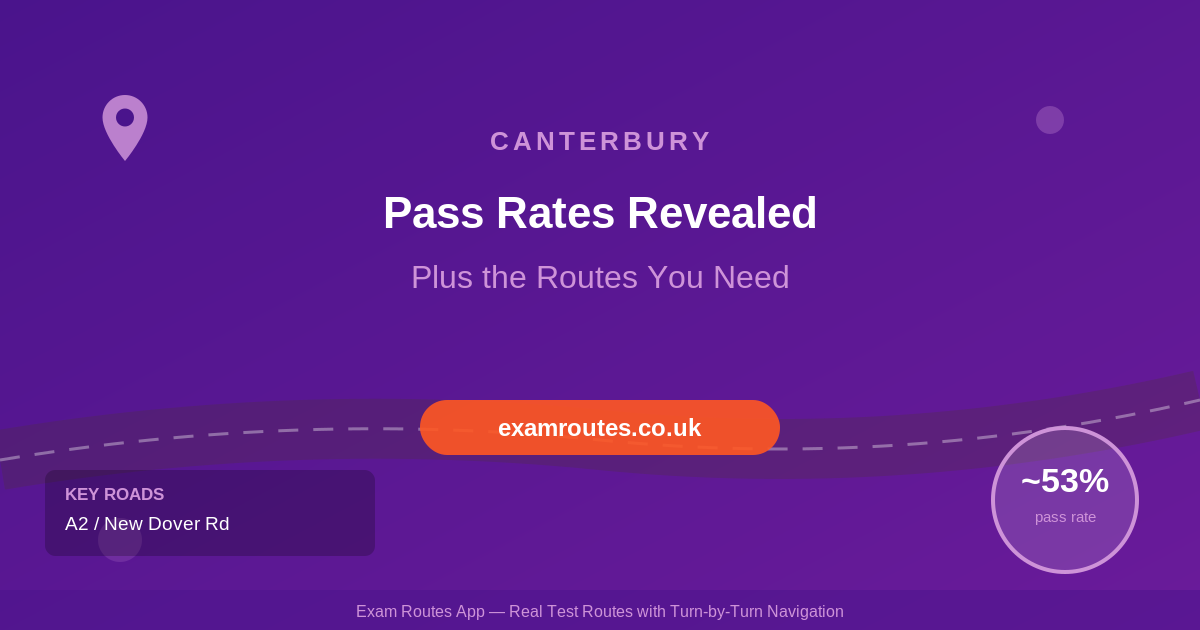
| Typical pass rate | Around 50–53%, generally above the national average |
| Roundabouts | Notably high – often around seven per route |
| Key roads | New Dover Road, A2, A2050, Upper Bridge Street, Ramsgate Road |
| Road mix | Dual carriageway, city ring roads, residential streets, rural lanes |
The Routes: Roads That Come Up Again and Again
New Dover Road and the southern approach
New Dover Road is one of the most consistent features of Canterbury routes. It is a busy road with side turnings, crossings and parked vehicles, and it links the city to the A2 corridor. Turning right out of side roads onto it is a common test of gap judgement.
The A2 and A2050 dual carriageway
Canterbury routes frequently include joining and leaving dual carriageway. This is the part learners most often under-practise. Joining needs you to build speed on the slip road and merge without hesitating; leaving needs your mirrors, signal and deceleration in the right order, using the deceleration lane rather than braking on the main carriageway.
Ramsgate Road and the eastern loop
Ramsgate Road brings roundabouts and pedestrian crossings in quick succession, plus the traffic generated by the retail and hospital areas nearby. Traffic density here varies enormously with the time of day.
Bekesbourne Road and rural lanes
South-east of the city the roads narrow quickly. Bekesbourne Road and the lanes around Bifrons Hill throw in bends, gradient, limited visibility and passing places. These stretches are where road reading is tested properly – you cannot rely on markings to tell you what is coming.
Upper Bridge Street and the ring road
Canterbury’s inner ring road system involves lane discipline, frequent traffic lights and pedestrians crossing in places you might not expect, particularly in term time when the universities are busy.
Practise Real Test Routes on Your Phone
The Exam Routes App gives you access to real driving test routes with turn-by-turn navigation. Practise at your own pace and build confidence before test day.
Tricky Spots and Common Challenges
- Sheer roundabout volume. With routes commonly featuring seven or more roundabouts, a single bad habit – late mirror checks, signalling on the roundabout rather than before the exit – gets repeated and marked repeatedly.
- Dual carriageway slip roads. Hesitating at the end of a slip road is one of the most serious faults you can pick up at Canterbury. Match the speed of traffic and go.
- Pedestrians in the city. Canterbury has a large student and tourist population. Expect people to step out, and expect crossings to be in constant use.
- Narrow rural lanes. Meeting a vehicle on a single-track lane with a hedge on one side requires calm reversing or good use of a passing place. Practise this – it is not intuitive.
- Cyclists everywhere. Canterbury has heavy bike traffic. The Highway Code expects at least 1.5 metres of clearance when passing at up to 30 mph, and examiners watch for it.
- Speed limit transitions. Going from 60 mph lanes into a 30 mph village and back is common. Anticipate the sign; do not brake heavily once you are past it.
Pass Rates and Statistics
Canterbury has been reported around the 50–53% mark, above the UK average for car tests, though published figures differ between sources and periods. What is more informative is the fault profile: at a roundabout-dense centre, the marks that cost people are overwhelmingly observation and lane discipline at roundabouts, followed by junction observation and inappropriate speed on rural sections.
Kent centres also share a practical problem – test availability. Waiting times across the south-east have run long, which means a fail costs you weeks, not days. That is a strong argument for going in genuinely ready rather than hoping for a lucky route.
Top Tips for Passing at Canterbury
- Over-practise roundabouts. If Canterbury throws seven at you, you want the routine to be automatic: mirrors, signal, position, speed, look, go.
- Nail the slip road. Practise joining the A2 until merging at speed feels normal.
- Drive the rural lanes. Book a lesson specifically on the narrow roads south-east of the city.
- Watch your clearance on cyclists. Give proper room, and wait behind rather than squeezing past.
- Time your practice. The city behaves very differently in term time and out of it.
- Use crossings properly. Approach ready to stop, do not wave pedestrians across, and do not creep forward while someone is still on the crossing.
- Keep making progress. Canterbury’s rural sections invite over-caution. Driving at 40 mph on a clear national speed limit road is a fault.
How the Exam Routes App Can Help
The Exam Routes App gives you real test routes with turn-by-turn navigation so you can drive Canterbury’s roundabout sequences, dual carriageway joins and rural lanes before the day that counts. Practise them until the route is boring – that is when you are ready.
Frequently Asked Questions
What is the pass rate at Canterbury driving test centre?
Canterbury generally reports around 50–53%, above the national average for car tests, although the exact figure moves between reporting periods.
Why do Canterbury tests have so many roundabouts?
The road network around the city funnels traffic through roundabout junctions, so almost any sensible route includes several. Route analysis regularly places Canterbury well above the UK average for roundabouts per test.
Will I go on a dual carriageway at Canterbury?
Very likely. The A2 and A2050 feature on many routes, and joining and leaving them is a standard part of the test here.
Are there rural roads on Canterbury test routes?
Yes. Lanes to the south-east of the city, including Bekesbourne Road, bring bends, limited visibility and passing places into play.
How long should I practise before booking at Canterbury?
There is no fixed number, but given the roundabout density and dual carriageway sections, most learners benefit from several lessons focused specifically on those two areas before taking the test.
Ready to Pass? Download Exam Routes Now
Get real test routes, turn-by-turn navigation and offline maps for test centres across the UK with the Exam Routes App. Practise where it counts.