The Insider Guide to Derby (Alvaston) Test Centre: Routes That Catch Learners Out in 2026
Ask instructors in Derby which candidates fail at Alvaston and you will hear the same answer over and over: not the nervous ones, the comfortable ones. Alvaston’s routes start in ordinary suburban streets and then, without much warning, hand you a multi-lane roundabout or a 50mph A-road where decisions have to be made quickly and correctly.
This is a centre where good drivers get caught out by pace rather than by difficulty. If your normal driving is careful but slow to commit, Derby will expose it. If you are quick to commit but sloppy with observation, it will expose that too.
Here is what actually happens on Alvaston test routes in 2026 — and how to prepare so nothing on the day is a surprise.
About Derby (Alvaston) Test Centre
The centre serves Derby from the Alvaston area on the south-east side of the city, close to the A6 London Road corridor. It is a residential-fringe location, which is useful for you: the roads immediately around it are ordinary suburban streets rather than a motorway junction, so the opening of your test is usually calm.
Before test day, sort the boring things out:
- Bring your photocard driving licence — no licence, no test.
- Make sure the car is roadworthy and legal: tyres above 1.6mm, all lights and indicators working, no warning lights on the dashboard, valid insurance and MOT, and L plates fitted.
- Arrive about 10 minutes before your slot, having already been to the toilet and had a drink of water.
- Have a plan for where your instructor or supervising driver will wait.
The Routes: Where Alvaston Tests Actually Go
Routes from Alvaston generally fan out in three directions, and most tests combine at least two of them.
South and east along London Road (A6)
London Road towards Chellaston and Shardlow is a staple. You get changing speed limits, a steady flow of traffic, bus stops, and several junctions where the examiner can watch how you emerge into moving traffic. Speed limit changes here are frequent enough that candidates regularly carry 40mph into a 30mph stretch without noticing.
North along the A52 and towards Spondon
This is where the pace steps up. The A52 corridor gives examiners dual carriageway conditions, lane changes and merging. Candidates who have only practised on quiet roads tend to hesitate here, and undue hesitation on a fast road is not a minor issue — it can become a serious fault if it causes other drivers to brake.
Inner suburbs: Allenton, Osmaston, Boulton and Alvaston itself
Tight residential grids with parked cars, 20mph zones, side road junctions every hundred metres and plenty of pedestrians. This is manoeuvre country and observation country. It is also where most minor faults are collected: mirror checks missed before signalling, position too close to parked cars, or rolling through a give-way line that was closed.
Roads and junctions to know before you test at Alvaston
- A6 London Road — changing speed limits, busy junctions, bus traffic
- A52 corridor towards Spondon — dual carriageway pace and lane discipline
- Kingsway and the larger ring-road roundabouts — multi-lane approach and exit
- Raynesway — fast, wide, and unforgiving of late lane decisions
- Alvaston, Allenton and Boulton estates — 20mph zones, parked cars, manoeuvres
- Chellaston direction — suburban A-road driving and steady progress
Tricky Spots & Common Challenges
The bigger Derby roundabouts. Multi-lane roundabouts around the ring road and the A52 junctions are the single biggest source of serious faults at this centre. Two rules solve most of it: read the sign early and choose your lane before the queue starts, and once you are committed to a lane, stay in it through the roundabout unless markings tell you otherwise.
Raynesway and fast A-road sections. The problem here is speed matching. Doing 40mph in a 50mph limit because it feels safer is not safer — it obstructs traffic and it will be marked.
London Road speed limit changes. Repeaters are easy to miss when you are concentrating on traffic. Get into the habit of consciously re-checking the limit every time the road character changes: after a junction, after a row of shops, after a bridge.
Parked cars on Alvaston and Allenton side streets. Meeting oncoming traffic is assessed constantly here. Examiners want to see you look far ahead, decide early whether to hold back or go, and position yourself where you can see and be seen.
Pedestrian crossings near shops and schools. Derby’s suburban parades have crossings right where traffic is heaviest. Cover the brake, watch the pavement, and never wave anyone across.
Practise Real Test Routes on Your Phone
The Exam Routes App gives you access to real driving test routes with turn-by-turn navigation. Practise at your own pace and build confidence before test day.
Pass Rates & Statistics
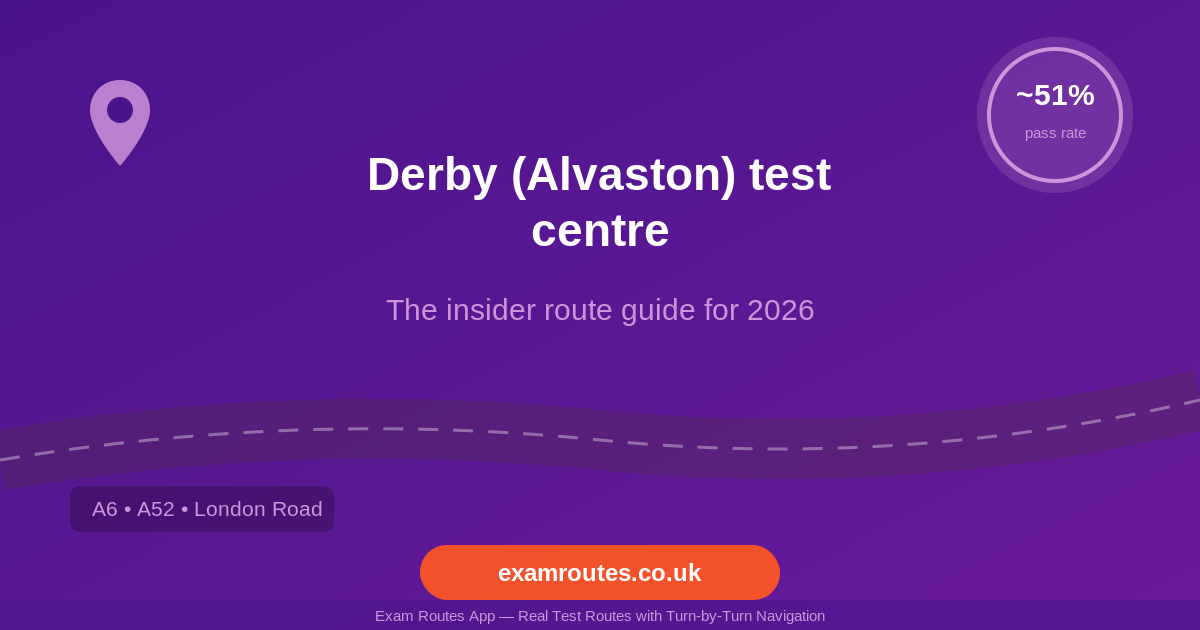
Derby (Alvaston) is usually reported with a pass rate around the 45–51% range depending on the source and period, which puts it at or slightly above the Great Britain average of roughly 48–50%. In other words, it is a fair test centre: not a soft option, but not one that quietly punishes candidates either.
The interesting figure is not the headline rate but the fault pattern. Nationally, the most common reasons for failing remain observation at junctions, use of mirrors when changing direction, steering control, incorrect positioning, and moving off safely. Alvaston routes are practically designed to test the first two of those, which is why local instructors focus so heavily on junction observation and mirror discipline.
Top Tips for Passing at Alvaston
- Master lane choice on multi-lane roundabouts. Practise the same roundabout from every direction until choosing the lane requires no thought.
- Practise on the A52 in traffic. Joining and leaving at realistic speeds is the skill that separates passes from fails here.
- Say the speed limit out loud in practice. It sounds silly and it works — especially along London Road.
- Rehearse meeting traffic on narrow streets until holding back feels natural rather than embarrassing.
- Do your mirror checks visibly. The examiner cannot mark what they cannot see. A clear, deliberate glance is enough.
- Practise all four manoeuvres in real, unfamiliar bays and streets — not just the same quiet cul-de-sac every week.
- Book a mock test at the same time slot as your real test so traffic conditions match.
How the Exam Routes App Can Help
Knowing which roads to practise is half the job. The Exam Routes App gives you real driving test routes with turn-by-turn navigation, so instead of driving randomly around Derby you can rehearse the corridors examiners actually use out of Alvaston — the A6, the A52 and the residential grids in between — as many times as you need.
Frequently Asked Questions
Where is Derby’s driving test centre?
Derby’s practical test centre is in Alvaston, on the south-east side of the city near the A6 London Road corridor.
Is Alvaston a difficult test centre?
It is a fair one. The suburban streets are straightforward, but the multi-lane roundabouts and faster A-road sections mean you need to be decisive as well as careful.
What pass rate does Derby (Alvaston) have?
Reported figures generally sit in the mid to high 40s, with some sources putting it around 51% — broadly around or slightly above the national average.
Will my test go on a dual carriageway?
It often does. The A52 corridor is regularly used, so practise joining, merging and holding a safe following distance at speed.
How long is the practical driving test?
About 40 minutes of driving, including roughly 20 minutes of independent driving, one manoeuvre and possibly an emergency stop.
Get the Edge on Test Day in Derby
The Exam Routes App gives you access to real driving test routes with turn-by-turn navigation. Practise at your own pace and build confidence before test day.