Ross-on-Wye looks like the gentlest test centre in the country. A handsome market town above a river bend, quiet Herefordshire lanes, no gridlock, no tram lines, no six-lane gyratory. Then you take the test, and you discover the hills are steeper than they look, the lanes are narrower than they seem, and the M50 junction on your doorstep means fast traffic arrives from nowhere.
Ross catches learners out precisely because it looks easy. This is the insider guide: the roads examiners genuinely use, the mistakes that turn a comfortable drive into a fail, and how to prepare so the town’s quiet charm works in your favour.
About Ross-on-Wye Driving Test Centre
Ross-on-Wye serves south Herefordshire and the edge of the Forest of Dean, drawing candidates from the town, Lea, Weston under Penyard, Newent and the surrounding villages. It is a small centre with a modest number of test slots, so booking and rebooking both take patience.
Practical checklist:
- Photocard provisional licence and booking reference.
- Valid MOT, legal tyres, working lights, clean windows and an extra interior mirror.
- A reliable handbrake. Ross is built on a hill; you will use it.
- Arrive early — parking near small centres fills quickly and the town’s streets are tight.
The Routes
Within roughly 38 minutes an examiner has to cover town driving, rural roads, higher speeds, a manoeuvre and around 20 minutes of independent driving. Around Ross that gives a clear pattern.
The town centre and the hill
Ross sits on a sandstone bluff above the Wye. Streets climbing from the river towards the Market House — and the narrow lanes around the old town — combine gradient, parked cars and pedestrians in one place. Hill starts here are real hill starts.
The A40 and M50 junction
The A40 runs past Ross linking Monmouth and Gloucester, and the M50 begins nearby. Dual carriageway sections and slip roads give the examiner higher-speed assessment: merging, lane discipline, and making proper progress.
The A49 towards Hereford
Fast, undulating and busy with commercial traffic. Overtaking opportunities are limited, so patience and following distance matter.
Herefordshire lanes
Out towards Weston under Penyard, Peterstow and the villages, roads narrow to single track with high hedges, blind bends and passing places.
Residential estates
The estates on the edges of Ross provide the quiet kerbed roads used for manoeuvres.
Practise Real Test Routes on Your Phone
The Exam Routes App gives you access to real driving test routes with turn-by-turn navigation. Practise at your own pace and build confidence before test day.
Tricky Spots and Common Challenges
Hill starts on the town’s slopes. Rolling back on a steep street with a car behind is one of the most common Ross faults. Handbrake on, find the biting point, feel the car settle, release smoothly.
Joining the A40 and M50 slip roads. Traffic here is quick. Build your speed on the slip road, take a decisive blind-spot check, and merge without forcing anyone to lift off. Stopping at the end of a slip road is close to the worst thing you can do.
Single-track lanes with high hedges. Visibility is genuinely poor. Drive at a speed that lets you stop in the distance you can see to be clear, and know where the last passing place was.
Tourist traffic. The Wye Valley is a holiday area. In summer expect motorhomes, caravans, coaches and drivers who are lost and braking unpredictably. Extend your following distance.
Cyclists. The Wye Valley is popular with cycling groups. Give at least 1.5 metres at up to 30mph and more above that. Waiting for a clear stretch is always the right call.
Wet leaves, mud and flooding. Rural Herefordshire lanes gather mud from farm vehicles and leaf fall in autumn. The Wye is prone to flooding after heavy rain, and standing water on approach roads is a real winter feature. Slow before it, not on it.
Pass Rates and Statistics
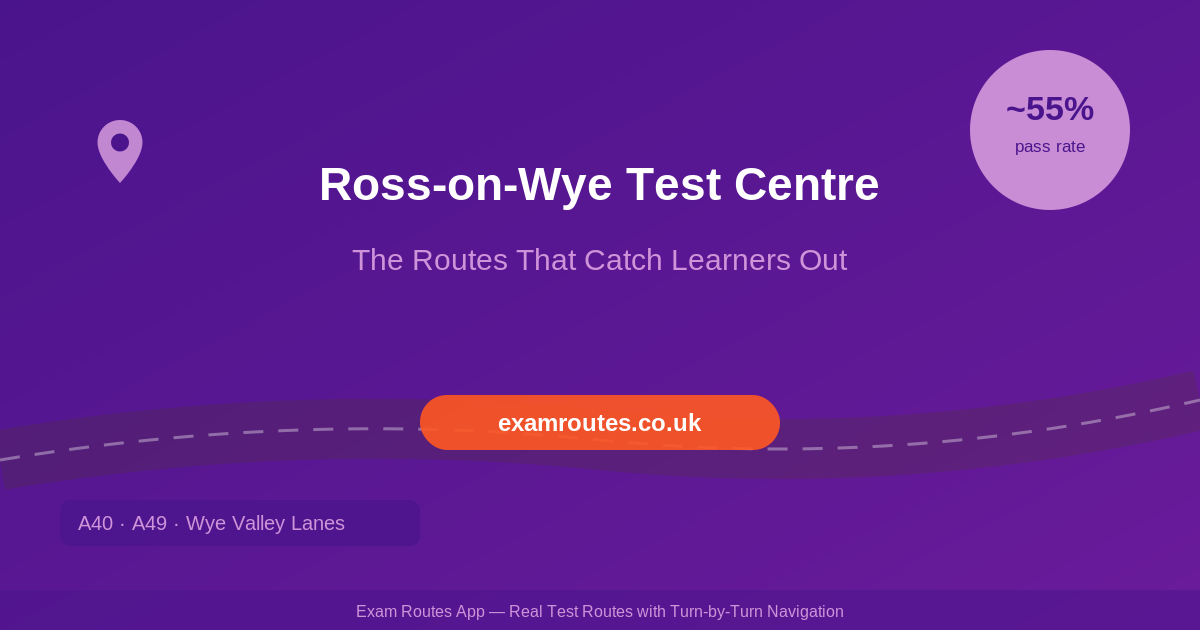
The national car practical pass rate sits at around 48–50% in the DVSA’s most recent published data. Small rural centres in Wales and the west of England have historically reported figures above the national average, and Ross-on-Wye’s mix of light traffic and simple junction layouts fits that pattern.
But look at why rural candidates fail and the picture changes. It is rarely a complicated roundabout. It is speed judgement on country roads, hesitation at junctions, poor observation on bends, and rushed decisions around slow-moving traffic. Those are all preparation problems, not centre problems.
The DVSA publishes up-to-date pass rates for every test centre on gov.uk each quarter.
Top Tips for Passing at Ross-on-Wye
- Practise hill starts on the town’s steepest streets, with traffic behind you.
- Do several A40 and M50 slip-road joins so merging at speed is routine.
- Make proper progress on rural roads. If the road is clear, straight and dry, driving well under the limit will be marked.
- Learn passing-place etiquette on the single-track lanes.
- Plan for tourists in summer — expect sudden braking and wide vehicles.
- Practise in the wet. Muddy, leaf-covered lanes behave very differently from a dry August afternoon.
- Get all four manoeuvres reliable, especially reverse parking on a slope.
How the Exam Routes App Can Help
Ross-on-Wye’s routes are hard to guess at, because so much depends on which direction the examiner heads out of town. The Exam Routes App gives you real test routes with turn-by-turn navigation, so you can practise the hill sections, the A40 slip roads and the lanes towards the villages before the day arrives.
Drive one route end to end with your instructor or supervising driver, then go back and repeat the hills and the narrow lanes until they feel unremarkable.
Frequently Asked Questions
Is Ross-on-Wye an easy driving test?
The roads are quieter than a city, but the test is not easier. Hills, single-track lanes, tourist traffic and fast A-road merging all feature, and rural candidates most often fail on speed judgement and hesitation.
Will I go on the motorway?
You will not be taken onto the M50 itself as a learner on test, but the A40 dual carriageway and the slip roads around the junction are realistic parts of a route. Practise merging at speed.
What is the biggest cause of failure here?
Nationally, the top faults are observation at junctions, mirrors before changing direction, and steering control. At rural centres, add undue hesitation and inappropriate speed on country roads.
How busy does Ross get in summer?
Wye Valley tourism brings caravans, motorhomes and coaches through the area from spring onwards. It rarely gridlocks, but it does add unpredictable, slow-moving traffic to test routes.
How far ahead should I book?
Small centres have limited slots and waiting times can run into months. Book early, and check the official DVSA booking service regularly for cancellations rather than paying a third party.
Don’t Book Ross-on-Wye Until You’ve Practised These Routes
The Exam Routes App gives you the real routes with turn-by-turn navigation — hills, lanes, slip roads and all.