South Uist 2026: The Complete Route Guide to Passing Your Driving Test
South Uist is one of the smallest and most remote practical driving test centres in the United Kingdom, serving learners across the southern Outer Hebrides. Tests run from Lochboisdale, and the route network is built around one spine road — the A865 — with a handful of village roads and townships branching off it. If you are preparing for a test here in 2026, this guide covers what the centre is like, which roads examiners use, what the local pass rate really tells you and how to prepare for the specific demands of island driving.
The headline point is simple: an island test is not a soft test. There are fewer junctions to get wrong, but there is nowhere to hide when it comes to speed judgement, observation on long open stretches and confident use of passing places. Examiners here see the same faults recorded everywhere else — junctions, road positioning, mirrors and undue hesitation.
| Location | Lochboisdale, South Uist, Western Isles, HS8 5TH |
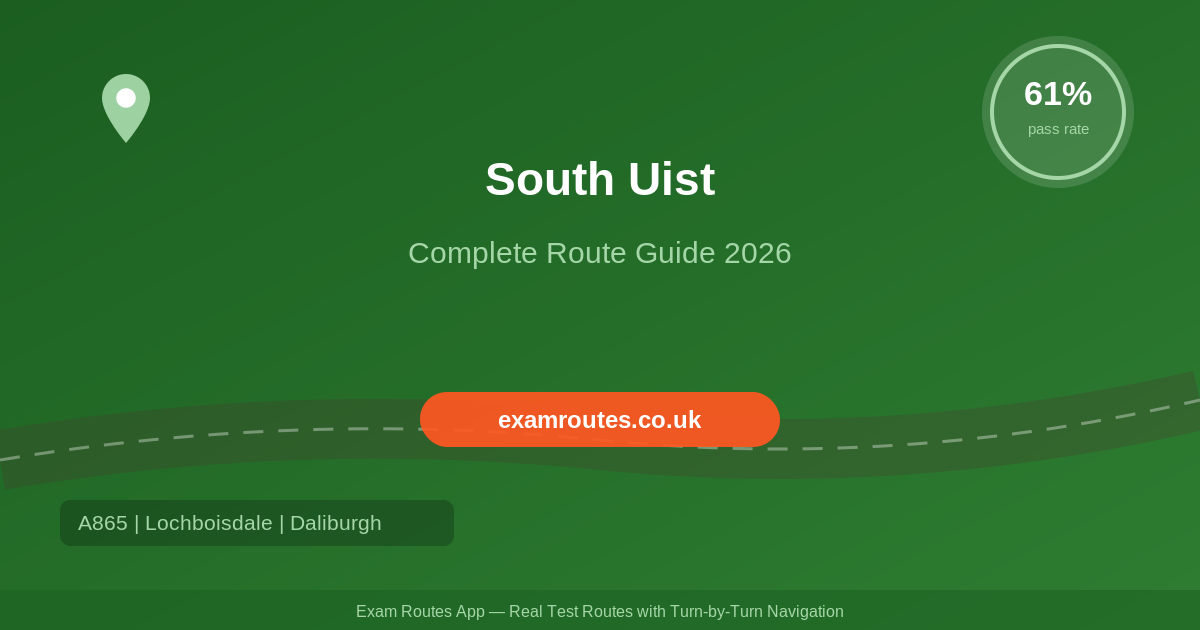
| Pass rate | Around 61% — one of the higher rates in the UK |
| Test type | Car practical only, with limited test slots |
| Typical route length | Around 10 miles across 38–40 minutes |
| Dominant road types | A865 single carriageway, township roads, 30mph village limits |
| Nearby centre | Benbecula, to the north across the causeways |
About South Uist Test Centre
Tests are booked through the standard DVSA booking service, but availability is limited because examiners cover the islands on a rota. If you are offered a slot that suits you, take it — and be ready. Cancelling late here can mean a long wait for the next opportunity.
Before you arrive, check the basics. Your provisional licence must be with you. The car must be roadworthy, taxed, insured for the test, fitted with an extra interior mirror and free of dashboard warning lights. On the islands, salt spray and weather take a toll on wipers and bulbs, so give both a proper check the day before rather than the morning of the test.
The Routes
Because the road network is compact, most tests draw on the same handful of areas. Expect a combination of the following:
- The A865 north and south. The main artery of the island, largely national speed limit, with long sightlines, gentle bends and occasional single-track sections. This is where the examiner assesses whether you can make appropriate progress.
- Daliburgh. The junction area and village roads here provide the closest thing to town driving on the route, with a genuine mix of turns, give-way lines and pedestrian activity.
- Lochboisdale and the ferry road. Traffic peaks around ferry arrivals and departures, which introduces a different rhythm to the road.
- Township roads and side streets. Narrow, often with a pronounced camber, used for manoeuvres and for turning the car around.
- The causeway approaches towards Benbecula. Exposed, straight and often windy — a good test of steering control and lane discipline.
Tricky Spots & Common Challenges
Wind. This is the challenge candidates from the mainland underestimate. Crosswinds on exposed sections and causeways push the car, and gusts can be sudden. Keep a firm but relaxed grip, avoid oversteering and allow extra room when passing high-sided vehicles or cyclists.
Making progress on the A865. Long empty roads tempt nervous candidates into sitting well below the limit. If conditions allow it, drive to the limit. Persistently driving too slowly for no reason is recorded as a fault and, if it holds up other traffic, can be marked as serious.
Single-track sections and passing places. Read the road well ahead, choose your passing place early and stop where the other driver can pass safely. Do not park in a passing place, and do not creep forward hoping the other driver will solve the problem for you.
Animals and agricultural traffic. Livestock on the road and slow-moving tractors are routine. Anticipate, slow smoothly and pass with plenty of clearance only when you can see it is safe.
Loose surfaces and standing water. Sand blown across the road near the machair and standing water after heavy rain both reduce grip. Adjust speed before the hazard, not in the middle of it.
Practise Real Test Routes on Your Phone
The Exam Routes App gives you access to real driving test routes with turn-by-turn navigation. Practise at your own pace and build confidence before test day.
Pass Rates & Statistics
South Uist records a pass rate of roughly 61%, which places it well above the UK average of around 50% and in line with other Highlands and Islands centres. The reasons are structural rather than a matter of leniency: fewer vehicles, fewer complex junctions, no multi-lane roundabouts and far less of the queuing and lane-changing pressure that produces faults in cities.
Two caveats matter. First, the number of tests conducted at a centre this small is low, so the percentage swings noticeably year to year. Second, the standard applied by the examiner is identical to that at any mainland centre. A higher headline rate is not a reason to book before you are ready.
Top Tips for Passing at South Uist
- Practise on windy days on purpose. Learning how the car behaves on an exposed stretch in a strong crosswind is genuinely useful preparation here.
- Fix your speed judgement. Drive the A865 repeatedly until sitting at the limit feels normal and slowing for bends becomes instinctive rather than anxious.
- Master passing places. Decide early, position clearly, and acknowledge other drivers courteously.
- Rehearse manoeuvres on a real cambered township road, where the car will roll if you release the brake carelessly.
- Practise the independent driving section with a sat nav, so that following directions while maintaining observation feels routine.
- Check your car the day before. Bulbs, wipers, tyre pressures and screenwash — a failed light means a cancelled test.
- Do not over-caution at junctions. Look properly, then go when it is safe. Waiting for a completely empty road is a fault, not a virtue.
How Exam Routes App Can Help
The Exam Routes App gives you real driving test routes with turn-by-turn navigation, so you can practise exactly the kind of roads your examiner is likely to use. For island learners, that means repeating the A865 stretches, the Daliburgh junctions and the village roads until they feel completely familiar — and using your limited practice time on the sections that actually matter.
Frequently Asked Questions
How many test slots are available at South Uist?
Availability is limited because examiners cover the islands on a rota rather than being based there full time. Check the DVSA booking service regularly and take a suitable slot when one appears.
Is the South Uist test genuinely easier?
The pass rate is higher, but the marking standard is the same. Rural routes contain fewer complex junctions; they also expose weak speed judgement and hesitation far more clearly.
Do I need to be confident on single-track roads?
Yes. Passing places are a normal part of driving here, and handling them decisively and safely is expected.
What if the weather is severe on my test day?
The DVSA cancels tests when conditions are genuinely unsafe, such as ice, snow, flooding or very high winds. You will be offered another date and should not be charged for a weather-related cancellation.
Can I take my test at South Uist if I learned elsewhere?
You can book any centre, but travelling to unfamiliar roads is rarely wise. Practise locally first if you intend to test here.
Get the Edge on Test Day
Download the Exam Routes App and practise real test routes with turn-by-turn navigation before your examiner picks one for you.