Portsmouth is a test centre with a distinct personality. It sits on the slopes below Portsdown Hill, north of the city itself, which means hills, gradients and fast dual carriageways feature far more heavily than they do at a flat inner-city centre. Hill starts here are not a novelty exercise — they are simply part of driving in the area.
Here is what you need to know about passing at Portsmouth in 2026: the centre, the roads, the faults that keep coming up, the pass rate in context, and a preparation plan that actually matches the test.
About Portsmouth Driving Test Centre
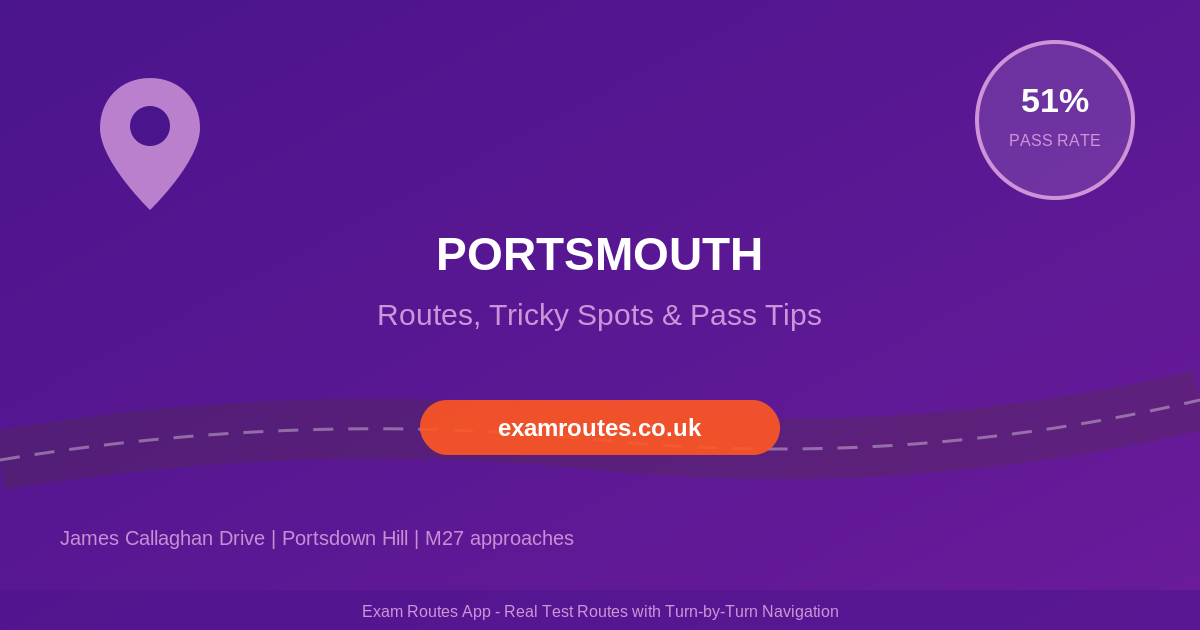
The practical test centre is on James Callaghan Drive, opposite Fort Southwick, Portsmouth PO17 6AR, up on the Portsdown Hill side of the city near Paulsgrove and Southwick. It is a slightly unusual location — reasonably exposed, with the road climbing away from the centre in one direction and dropping towards the city in the other.
That geography is the first thing to plan for. Getting to the centre from central Portsmouth means a climb; leaving it can mean an immediate downhill approach to a junction. If you have only ever practised on the flat around Southsea, book at least two sessions specifically on the hill.
Parking at the centre is available but not generous. Arrive around ten minutes early with your provisional licence and booking confirmation, and make sure the car is legal, taxed, insured for the test, showing no warning lights and fitted with L plates and an extra interior mirror.
The Routes: Which Roads Portsmouth Examiners Use
Test routes are not published by the DVSA, but the road network around James Callaghan Drive limits the sensible options. Expect a mix of:
- James Callaghan Drive and Southwick Hill Road — gradient work from the first minute, with junctions on a slope.
- Portsdown Hill Road (B2177) — sweeping, faster, with excellent views and some genuinely demanding bends.
- The A3 and A27 corridors — dual carriageway sections testing joining, lane discipline and leaving safely.
- Paulsgrove and Wymering estates — residential streets used for manoeuvres and slow-speed control.
- Cosham High Street and the surrounding one-way sections — busy shopping traffic, crossings, buses and parked vehicles.
- Northarbour and Portsbridge roundabouts — multi-lane junctions where lane choice really matters.
A car test runs around 38 to 40 minutes with roughly twenty minutes of independent driving, one manoeuvre, and a one-in-seven chance of the emergency stop.
Tricky Spots and Common Challenges
Hill starts, everywhere. The single most Portsmouth-specific challenge. Pulling away uphill without rolling back, stopping on a gradient with proper handbrake use, and holding position in queuing traffic on a slope all come up naturally. Roll back more than a car’s length and you risk a serious fault.
Downhill approaches to junctions. Coming off the hill towards Cosham, your stopping distance stretches and your speed builds without you touching the accelerator. Brake earlier than instinct suggests and select the gear you actually need.
Portsbridge and Northarbour roundabouts. Multi-lane, busy, and feeding motorway-standard roads. Lane choice must be made on the approach, from the sign, not from the car in front.
Joining the A27 and A3. These are genuinely fast roads. Joining too slowly and forcing other traffic to brake is a common serious fault. Match the speed of the traffic on the slip road, check your mirror and blind spot, and merge decisively.
Cosham’s pedestrian traffic. The high street area produces the classic urban faults — stopping over a crossing, failing to spot a pedestrian already stepping off the kerb, or being caught out by a bus pulling away.
Weather and exposure. Portsdown Hill catches wind and low cloud. On a wet, windy day your positioning on the sweeping bends needs to be that bit more deliberate.
Practise Real Test Routes on Your Phone
The Exam Routes App gives you access to real driving test routes with turn-by-turn navigation. Practise at your own pace and build confidence before test day.
Portsmouth Pass Rates and Statistics
Portsmouth’s pass rate has recently been quoted in the 50–52% range, marginally above the national car test average of around 50%. Given the hills and dual carriageways, that is a respectable figure and suggests examiners here are running fair, predictable routes on demanding roads.
The interesting detail is that Portsmouth’s difficulty is concentrated in specific skills rather than spread evenly. Candidates who have practised hill starts and dual carriageway joining tend to find the test straightforward; candidates who have not tend to lose marks in clusters within the first ten minutes.
Across the UK, the fault categories that end most tests are junction observation, mirrors before changing direction, steering control, moving off safely and positioning. “Moving off safely” is disproportionately relevant at Portsmouth, because so many moves off happen on a gradient.
Top Tips for Passing at Portsmouth
- Practise hill starts until they are boring. Uphill, downhill, in traffic, at a junction, on a bend. This is the local skill that decides tests.
- Drive Portsdown Hill Road in both directions, in daylight and in wet weather if you can.
- Do at least three dual carriageway sessions on the A27 or A3, focusing on joining at the right speed and leaving in good time.
- Rehearse Cosham at a busy time. Pedestrian awareness cannot be learned on an empty road.
- Get your handbrake habits right. On slopes, use it. Examiners are not counting handbrake applications; they are watching whether the car stays still.
- Learn the multi-lane roundabouts by sign. Northarbour and Portsbridge punish late decisions.
- Book a mock test that starts and finishes at James Callaghan Drive so the first two minutes are familiar.
How the Exam Routes App Can Help
Portsmouth’s route pool covers hill roads, fast A-roads and busy urban centres — three very different environments. Covering all of them in a handful of hour-long lessons is difficult. The Exam Routes App gives you real test routes with turn-by-turn navigation so you can drive them with a supervising driver, at your own pace, until the gradients and slip roads stop feeling like events.
Frequently Asked Questions
Where is Portsmouth driving test centre?
James Callaghan Drive, opposite Fort Southwick, Portsmouth PO17 6AR, on the Portsdown Hill side of the city near Paulsgrove and Southwick.
What is the pass rate at Portsmouth?
Recent figures place Portsmouth around 50–52%, slightly above the national car test pass rate of roughly 50%.
Are hill starts common on the Portsmouth test?
Yes. The centre sits on a hill, so moving off on a gradient, stopping on a slope and holding position in queuing traffic all occur naturally on the routes.
Does the Portsmouth test include a dual carriageway?
Frequently. The A27 and A3 corridors mean many routes include a fast section, so practise joining, lane discipline and leaving safely.
What is the hardest part of the Portsmouth test?
Most local instructors point to the combination of gradients and fast roads. If you are confident on hill starts and comfortable joining a dual carriageway, the rest of the route is fair.
Don’t Leave Your Test to Chance
Real routes, turn-by-turn navigation and centre-by-centre coverage. Get the Exam Routes App and walk into your test knowing the roads.