Aylesbury is one of those test centres that looks straightforward on a map and then quietly catches people out. The town has grown fast, the ring road carries a lot of commuter traffic, and the examiner has an unusually wide menu of road types to choose from within a fifteen-minute drive of the centre. You can be crawling through a residential estate one minute and joining a 70 mph dual carriageway the next.
That variety is exactly why so many learners book Aylesbury without preparing properly. If you have only ever driven with your instructor on the same two or three familiar loops, the test can throw a road type at you that you have barely touched. This guide walks through the roads Aylesbury examiners genuinely use, the junctions that generate the most faults, and a practical plan for getting your practice hours in the right places before you commit to a date.
Aylesbury Driving Test Centre: The Basics
Aylesbury’s practical test centre sits on the western edge of the town, close to the Rabans Lane industrial area and within easy reach of both the A41 and the town centre. There is limited parking on site, so the standard advice applies: arrive about ten minutes early, park where your instructor normally parks rather than improvising, and give yourself a moment to settle before you go in.
Bring your provisional photocard licence and make sure your test vehicle meets DVSA requirements — legal tyres, working lights, a clean windscreen, a passenger-side mirror and L plates. A car that fails the basic check means a cancelled test and a lost fee, and it happens more often than people expect.
Waiting times: Aylesbury is a popular centre serving a wide catchment across Buckinghamshire, so slots go quickly. Because the DVSA now limits you to two changes per booking, treat the date you pick as close to final and build your practice plan around it.
The Routes: Where Aylesbury Examiners Actually Take You
The DVSA stopped publishing official test routes years ago, but the road network around Aylesbury constrains the options heavily. In practice, routes from the centre tend to fall into four families.
1. The A41 bypass loop
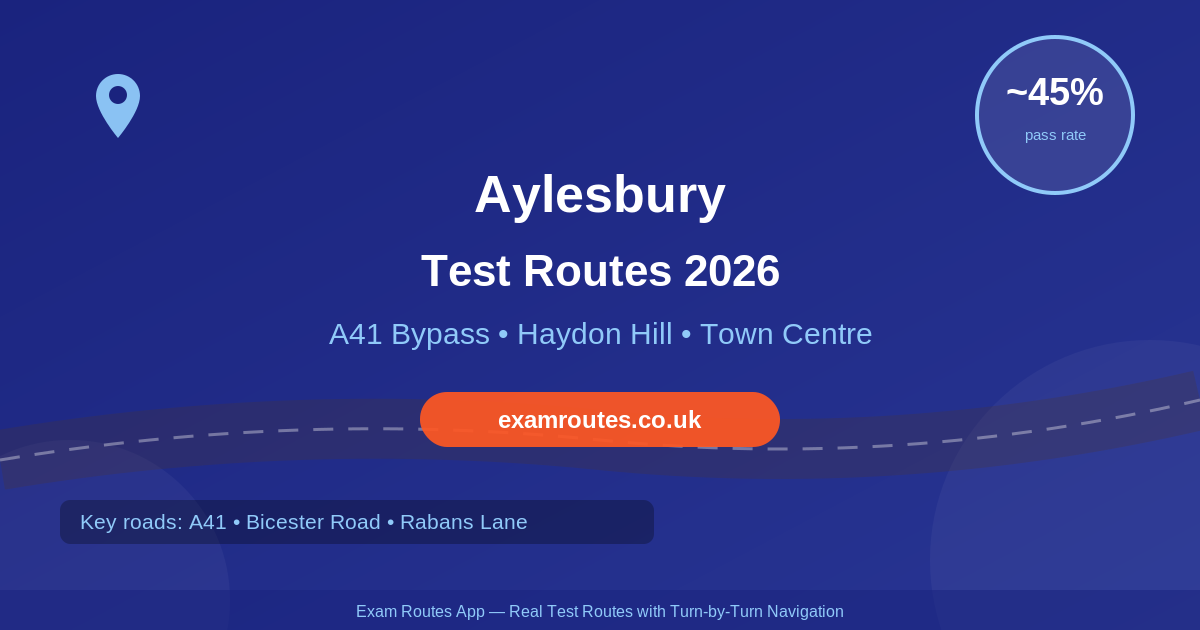
Almost every Aylesbury candidate meets the A41 at some point. It is a fast, flowing road with generous sightlines, and the fault it produces most often is not speeding — it is hesitancy. Learners approach a slip road or a roundabout entry, lose their nerve at 40 mph in a 60 or 70 zone, and pick up an undue hesitation fault or force following traffic to brake. Practise building speed decisively on the approach and matching the flow of traffic before you join.
2. Haydon Hill and the northern roundabouts
The roundabouts on the northern side of town are the classic Aylesbury trap. Several are multi-lane with painted arrows that change as you approach, and lane discipline on exit is scrutinised closely. If you drift out of your lane on the way round, that is a straightforward fault. Learn the lane markings by driving them repeatedly rather than trying to read them under pressure on the day.
3. The town centre one-way system
Aylesbury’s inner roads mix bus lanes, pedestrian crossings, loading bays and short filter lanes. Positioning is the theme here. Sitting too far left near parked cars, or too far right because you are anticipating a turn early, both cost marks. So does a late lane change when a sign appears sooner than you expected.
4. Residential estates for manoeuvres
Quieter roads near Rabans Lane, Stocklake and the estates off Bicester Road are the usual venues for the reversing exercises and the controlled stop. They are wide enough to be fair and quiet enough to be safe, but they are also full of parked cars, dropped kerbs and driveways — so your observations while reversing need to be genuine, not performative.
Practise Real Test Routes on Your Phone
The Exam Routes App gives you access to real driving test routes with turn-by-turn navigation. Practise at your own pace and build confidence before test day.
Tricky Spots and Common Challenges at Aylesbury
- Speed limit transitions. Roads into Aylesbury drop from national speed limit to 40 to 30 in quick succession. Missing a repeater sign and carrying 40 mph into a 30 zone is one of the most common serious faults at this centre.
- Multi-lane roundabout exits. Choosing the right lane on entry is only half the job. Holding it cleanly all the way round and signalling at the correct moment is where marks are lost.
- Cyclists on the ring road and town approaches. Aylesbury has a lot of cycle traffic. Under the Highway Code hierarchy of road users, you are expected to leave at least 1.5 metres when overtaking at speeds up to 30 mph, and more above that.
- Emerging from estate roads onto busy main roads. Junction observation and a decisive but safe gap selection is assessed hard here. Creeping forward repeatedly without committing reads as poor judgement.
- Independent driving with the sat nav. Aylesbury’s newer housing developments have similar-sounding road names and a lot of curved layouts. Following the sat nav calmly, and staying safe when it gives a late instruction, matters more than getting every turn right.
Pass Rates and Statistics
Aylesbury’s pass rate sits close to, and in most recent years slightly below, the national average of roughly 50%. Reported figures vary between sources and reporting periods, generally landing in the mid-40s to low-50s. Take any single number with caution: pass rates are heavily influenced by how well prepared local candidates are, not just by how hard the roads are.
| What the number tells you | What it doesn’t |
|---|---|
| Roughly how many candidates at this centre pass on a given attempt | How hard the routes are for you specifically |
| Whether the centre is broadly typical of UK centres | Whether you personally have enough hours on fast roads |
| A rough benchmark for setting expectations | Which examiner you will get or which route you will drive |
The practical takeaway is simple. A pass rate near the national average means Aylesbury is a fair test, not an unusually punishing one. Candidates who fail here usually fail on preparation, not on bad luck.
Top Tips for Passing at Aylesbury
- Get real time on the A41. If joining and leaving a fast road still makes you tense, you are not ready to book. Aim for several sessions where merging feels routine.
- Drive the northern roundabouts until lane choice is automatic. Do them in both directions, at different times of day.
- Practise the town centre in traffic, not on a Sunday morning. An empty one-way system teaches you nothing about lane discipline under pressure.
- Rehearse manoeuvres on roads with parked cars. The estates near the centre are never empty on a weekday, so practising on a bare street is a false comfort.
- Check your speed on every limit change. Make a habit of glancing at the speedometer immediately after passing a limit sign, every single time.
- Use a sat nav in practice. Twenty minutes of independent driving is a long time to be improvising with an unfamiliar device.
- Book a slot outside the school run. Mid-morning and early afternoon are calmer on Aylesbury’s ring road than 08:30 or 15:15.
How the Exam Routes App Helps at Aylesbury
The Exam Routes App gives you real driving test routes for UK test centres with turn-by-turn navigation, so you can drive the actual roads your examiner is likely to use rather than guessing. For a centre like Aylesbury, where the difficulty is spread across four quite different road types, that structure is the difference between practising and just driving around. You can repeat a route as many times as you like, work on the sections that unsettle you, and turn up on test day having already seen the junctions.
Frequently Asked Questions
Is Aylesbury a hard driving test centre?
No — it is a fair, mid-table centre. Its pass rate sits close to the national average. What makes it feel hard is the range of road types packed into a short route: fast dual carriageway, multi-lane roundabouts, a busy one-way system and quiet estates.
Do Aylesbury tests always use the A41?
Not always, but very often. The A41 is the obvious fast road available to examiners from this centre, so you should assume you will drive part of it.
How long is the driving test at Aylesbury?
A standard car test lasts around 38 to 40 minutes of driving, plus the eyesight check, the ‘show me, tell me’ questions and the debrief afterwards — so budget about an hour in total.
Can I take my test at Aylesbury if I live elsewhere?
Yes, but since June 2026 you can only move an existing booking to one of the three test centres nearest your original choice. If you want Aylesbury, book it directly rather than planning to switch.
What is the most common reason people fail at Aylesbury?
Speed and observation faults tied to the limit changes on the approaches into town, followed by lane discipline on the larger roundabouts.
Ready to Pass at Aylesbury? Get the Routes First
Download the Exam Routes App and practise the roads your examiner actually uses — turn-by-turn, at your own pace, as many times as you like.